
Georgia Country Profile
At the crossroads between Europe and Asia, Georgia’s millennia-old cultural tradition today intertwines with a modern vision that is open to foreign investments, digital innovation, and the development of international economic relations.
With its strategic location and rich historical heritage, Georgia positions itself as a dynamic hub for regional and global trade. Recent structural reforms, a favorable business environment, and an increasing openness to foreign markets have made the country an attractive destination for businesses and investors looking for new opportunities in agriculture, technology, tourism, and industry.
In this context, the promotion of local excellences – from wine to manufacturing – is complemented by the growing digitization of processes and the strengthening of infrastructure, making Georgia fertile ground for entrepreneurial initiatives focused on sustainable growth and international cooperation.
Ethnic Composition and Cultural Diversity
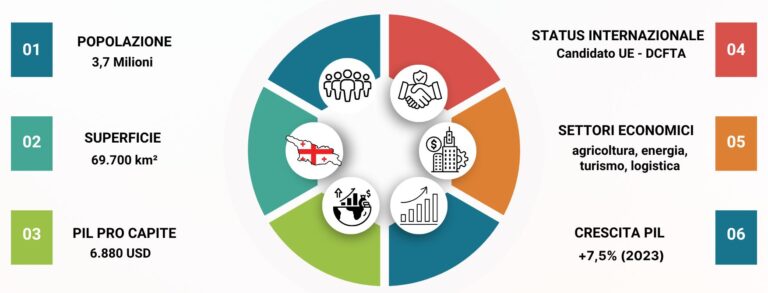
Georgia is a country characterized by rich cultural and ethnic diversity, with a history of peaceful coexistence among various groups. According to the National Statistics Office of Georgia, the country’s population was estimated at about 3.7 million as of January 1, 2025. According to recent censuses, around 86.8% of the population is of Georgian ethnicity. The main ethnic minorities include Azerbaijanis, Armenians, Russians, Ossetians, Abkhazians, Assyrians, Greeks, Jews, Yazidis, Kists, and Ukrainians.
Demographic Trends
In recent decades, Georgia has undergone significant demographic changes influenced by migration, urbanization, an aging population, a decline in birth rates, and high levels of emigration, particularly among young adults. These dynamics have a significant impact on the labor market and the education system.
Demographic structure by age group:
Under 15 years: 19.5%
15–29 years: 17.4%
30–44 years: 21.4%
45–59 years: 18.7%
60–74 years: 17.1%
75–84 years: 4.6%
85 years and over: 1.3%
The official language is Georgian, spoken by approximately 87.7% of the population. It is used in government, education, and public life. Georgian belongs to the Kartvelian (South Caucasian) language family and has its own alphabet, developed around the 5th century, with numerous dialects. The main languages spoken after Georgian are Azerbaijani (6.2%), Armenian (3.9%), and Russian (1.2%). Abkhaz is co-official in the autonomous region of Abkhazia. Other Kartvelian languages spoken in Georgia include Mingrelian, Svan, and Laz.
English is increasingly gaining importance in the education system, especially in higher education institutions and international schools. It is considered the first foreign language and is widely used in public life as well.
Religious freedom is guaranteed by the Constitution, and religious diversity is generally respected, although the Georgian Orthodox Church still exerts significant cultural and social influence, including in the field of education. About 83.4% of the population adheres to Georgian Orthodox Christianity, which plays a central historical and cultural role.
Other religious groups include Muslims (10.7%), mainly concentrated in the autonomous region of Adjara, as well as small communities of Armenian Christians, Catholics, and Jews.
Geography and Location
Georgia is located at the crossroads between Eastern Europe and Western Asia, in the South Caucasus region, covering an area of 69,700 km².
It borders Azerbaijan to the southeast, Armenia and Turkey to the south, Russia to the north, and has a coastline on the Black Sea to the west. Its strategic location along the historic Silk Road and modern energy corridors has defined its geopolitical importance over the centuries.
The country features a surprisingly diverse landscape: high mountain ranges, fertile river valleys, and subtropical coastlines. Georgia is predominantly mountainous, situated almost entirely in the Southern Caucasus. The Greater Caucasus Mountains dominate the northern border, while the central part consists of plains and low hills.
Major Cities
The population is largely concentrated in urban areas, particularly in Tbilisi, the capital. More than half of the population now lives in cities. However, rural areas remain significant due to the prevalence of labor-intensive agricultural activities, such as tea cultivation and subtropical crops.
Major cities:
Tbilisi – The capital and largest city of Georgia, it is the political, cultural, and economic center of the country and a strategic crossroads between Europe and Asia.
Kutaisi – One of Georgia’s oldest cities, formerly the capital of the Kingdom of Colchis and later of Imereti, today it is an economic and educational hub in western Georgia.
Batumi – Located on the Black Sea coast, Batumi is a major tourist destination and the seat of the Autonomous Republic of Adjara.
Poti – An important port city on the Black Sea, Poti is a key hub for the country’s imports and exports.
Topography and Biodiversity
Georgia’s varied topography contributes to a wide range of microclimates and remarkable biodiversity, despite the relatively small size of the country. The presence of mountains, hills, plains, and valleys creates a complex and dynamic physical landscape. This diversity supports a rich agricultural tradition and is a strength for sustainable development and ecological investments.
Georgia is home to around 5,600 animal species, many of which are endemic, making it a unique opportunity for scientific research, pharmaceutical innovation, and eco-tourism. It is also considered an underexplored hotspot for the biotech sector, agriculture, and biological research, particularly concerning fungal species, which makes it attractive for herbal and botanical industries. This ecological heritage creates ideal conditions for agricultural diversification, wildlife conservation, and the development of green projects.
Thanks to favorable regulations for ecological sectors and the country’s climate commitments, there are clear incentives to invest in organic farming, sustainable forestry, and eco-tourism.
The climate of Georgia is extremely varied. There are two main climatic zones, roughly corresponding to the eastern and western parts of the country. The Greater Caucasus Mountains play a key role in moderating the climate and protecting Georgia from cold air masses coming from the north, while the Lesser Caucasus offers some protection against hot and dry winds from the south.
The country features several agro-climatic zones, suitable for a wide range of crops and agricultural activities. This climatic richness, combined with fertile soils and abundant water resources, makes Georgia a promising destination for agricultural investments.
The two main climatic zones:
Western Georgia: A mild climate year-round, ideal for crops such as tea, citrus fruits, kiwi, and hazelnuts. The mountainous areas are suitable for forestry, livestock farming, and cold-climate crops.
Eastern Georgia: A transitional climate, with hot summers and colder winters. This climate favors viticulture and the cultivation of cereals. Rainfall is more seasonal (spring and autumn), while irrigation supports productivity during dry summers.
The Italy-Georgia Chamber of Commerce
Your Key Partner for Economic Relations Between Italy and Georgia
In recent years, Georgia has become a true example of modernization in the Caucasus. Through the Deep and Comprehensive Free Trade Area (DCFTA), Georgia has improved the quality of its exports and attracted foreign investments, while legislative and institutional reforms have made the country more competitive on the international stage. These advancements represent a significant opportunity for Italian businesses, especially in the infrastructure, renewable energy, and agri-food sectors, but also beyond.
The Italy-Georgia Chamber of Commerce is dedicated to supporting and fostering these opportunities, helping Italian companies expand into the Georgian market and vice versa. The synergies created by access to the European market and Italian investments in Georgia serve as a catalyst for both countries’ economic and cultural growth.